Better Together: Reflections on the SBC Annual Meeting and the Future of Cooperation
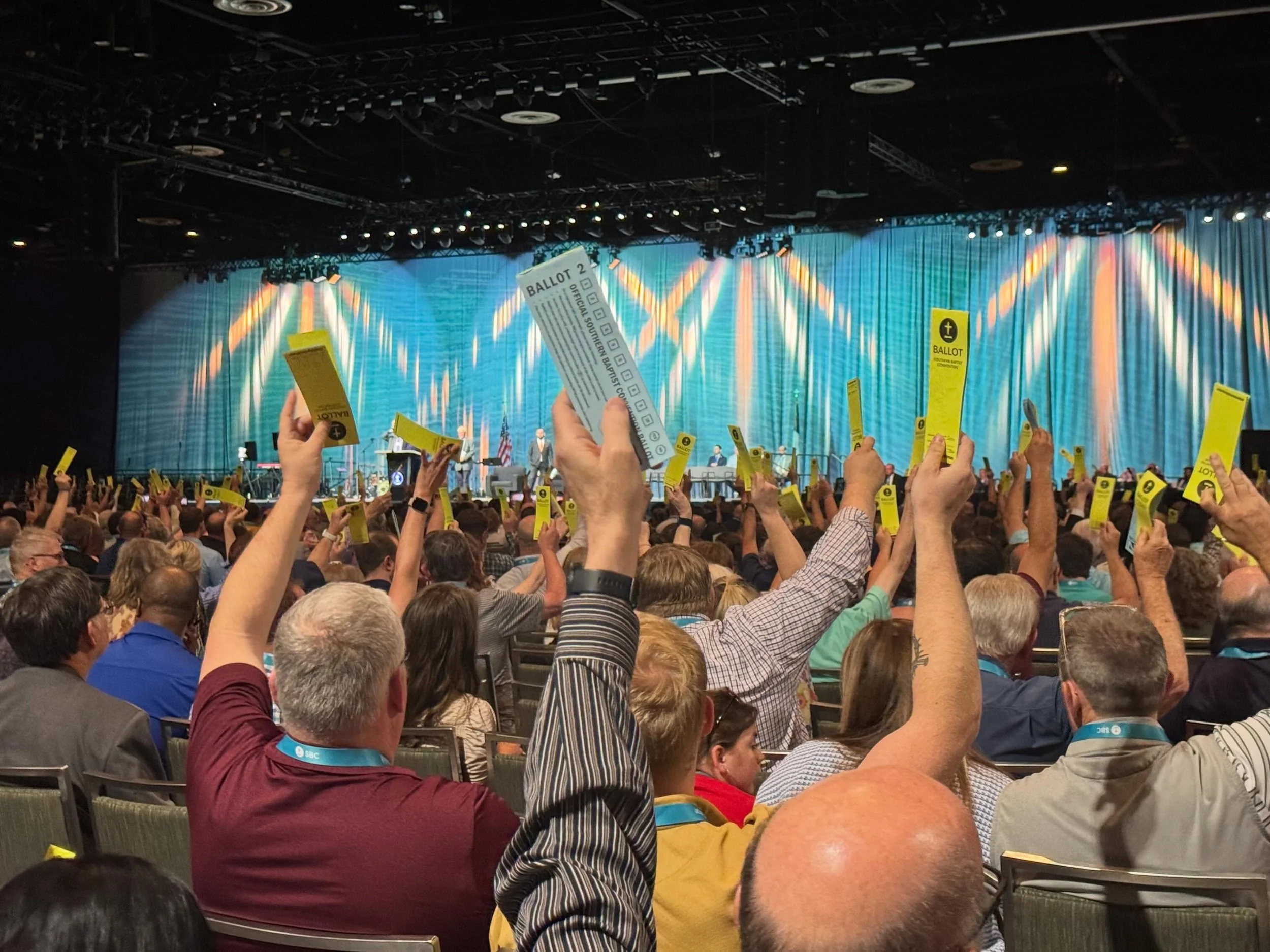
I attended the Southern Baptist Convention (SBC) annual meeting in Orlando last week. If you’re curious about what happens at the SBC and what it means for local churches, I wrote this for you. If not, I completely understand.
Before I begin, it should be noted that churches voluntarily and independently join associations, state conventions, and the SBC. This means UBA has churches that are not part of the SBC collaborating with SBC churches.
Similarly, we have churches from both state conventions serving alongside each other as part of UBA, and this system has served the association and our little slice of the Kingdom very well for decades. The reason for choosing the name “Union” in 1850 for the first association in Texas was that we were a “union” of different Baptist streams coming together to bring the gospel to this unsettled frontier.
I should also remind you that associations are not, nor have they ever been, recipients of Cooperative Program (CP) dollars. UBA is funded primarily (95%) by the churches it serves.
Sunday, June 7- Southern Baptist Conference of Associational Leaders (SBCAL)
Every year, the largest annual gathering of associational leaders (SBCAL) takes place before the convention starts. It’s a sort of mini-convention on Sunday and Monday that focuses on equipping and fellowship for associational leaders.
In years past, I have served on the leadership team of SBCAL, emceeed certain events, and been a plenary speaker. This year, I was a breakout speaker for those who are either new to their role as an associational leader or considering taking a leadership role.
I enjoy pouring into associational leaders because it was associational leaders who poured into me when I was starting out. It’s a unique fraternity, and some of the deepest friendships I have are with associational leaders.
Monday, June 8- SBCAL, the SEND Luncheon, the IMB dinner, and the SBTC.
The Pastor’s Conference runs Sunday through Monday night, so I rarely attend since it overlaps with SBCAL.
I attended several meetings with different IMB personnel, including one on Monday morning, and then the NAMB SEND luncheon at noon. This event usually attracts around 6,000 people. For the last ten years, donors have provided funds (not Cooperative Program money) to NAMB so it can bless someone and tell their story, which is a great part of the event. You can read more about the event and the families who were blessed here.
Monday afternoon is usually the only time I spend in the exhibit hall, walking around the booths and talking with friends from different organizations. Many people stop by the Guidestone booth to get a free health screening (check your blood pressure before the business meeting starts) and get an update on their retirement account. I also spent time with people from our associational partner, the Metro New York Baptist Association. They’re doing great work and ministry in an unchurched environment that most Houstonians can barely imagine.
Various dinners happen on Monday evening, and I typically attend the IMB dinner. It’s a great opportunity to celebrate what the Lord is doing through IMB and meet various missionaries from around the world. A few hours later, I attended the SBTC fellowship and caught up with various pastors and leaders from across Texas.
One of the true blessings of attending the SBC every year is the providential opportunities to have casual conversations in the hallways with almost anyone. I attended formal meetings to be sure, but also had meaningful, unplanned conversations with the EC president, leaders of both IMB and NAMB, vice presidents, both state convention leaders, seminary leaders and professors, and countless others.
Tuesday, June 9- Day 1 of the SBC Annual Meeting
The meeting starts at 8am with worship, and this year’s agenda was packed with business. It’s not uncommon for people to wander in and out of the main hall to hear reports that interest them or spend time in the exhibit hall, but I stay in the main hall virtually every minute of both days. The first introduction of new motions happens in this block of time, and Dr. Al Mohler began this year by introducing the “Truth and Unity Amendment.” More on that later.
A quick note of explanation might be useful here. Motions have staying power because they are recommended changes to the convention’s operations or governing structure. Therefore, motions are different from resolutions, which are public statements made by the convention's messengers and, in theory, have only the staying power of that annual meeting. Resolutions are like something spoken out loud at the convention that dies as quickly as the noise fades. Motions, however, are acted upon and adopted for future policies.
In my opinion, resolutions are an antiquated form of communication from a bygone era. They often deal with complicated subjects and are densely worded. The time dedicated to amending them is necessarily limited by other tasks to accomplish, and, given the subject matter of some resolutions, there is hardly time or expertise at the microphones to help the messengers fully consider the ramifications of each.
The first morning session rapidly culminates in the best moment of the entire convention: the International Mission Board missionary commissioning service. If you’ve never experienced the commissioning of new missionaries, it is simply awesome.
The rest of the day included various reports, more motions, the election of the new SBC president (Willy Rice), and the outgoing president’s address. Toward the end of the afternoon session, the convention voted to suspend the rule requiring amendments to the constitution to be sent to the Executive Committee (EC) before being considered by the messengers. This cleared the way for the convention to make one of two votes on the “Truth and Unity Amendment” at this year’s convention.
It should be noted that this year’s convention seemed singularly focused on Mohler’s amendment. Five motions to create task forces or study groups on various issues were “tabled indefinitely,” meaning no action will be taken on those subjects. Debates on various topics ended quickly with people “calling the question.” While the convention floor is not the most conducive place for productive dialogue, it's better than nothing, and it is often the only place people will hear a viewpoint other than the one they came with.
In my opinion, calling the question is a tactic used by those who just want to “win” for their perspective, and should be used sparingly. If we can’t listen to opposing viewpoints, we have lost the charity and grace that is supposed to be part of our fellowship.
Which brings me to the Truth and Unity amendment. The text of the amendment adds to the SBC's definition of a church in friendly cooperation with this: “Does not act to affirm, appoint, or endorse a woman serving in the office or function of a pastor/elder/overseer, specifically preaching to the assembled congregation.”
In some ways, this is the natural progression of the SBC’s strongly complementarian stance as demonstrated over the last several years. Proponents will say that this is merely a clarification and codification of that stance. The SBC has limited the office of senior pastor to men for decades. Proponents claim that any church using the title of pastor for roles that are not equivalent to elder/overseer (children’s, worship, etc.), and, more specifically, for women in those roles, promotes a sloppy ecclesiology and doctrine. Numerous articles explain this position, but Mohler explains his amendment here.
Opponents have also published numerous viewpoints, among them the view that the Baptist Faith and Message 2000 (BF&M2000) is already sufficient on this matter, and that mechanisms are already in place to find churches “not in friendly cooperation” should they have women serving as pastors. Opponents have also said this infringes on local church autonomy, since the SBC is not a hierarchical, top-down denomination.
In any case, the amendment was approved by 74.66% of messengers, and now the SBC must pass it again in Indianapolis next year before it has any force or effect.
Several dinners and fellowships are available on Tuesday night, and I attended the BGCT fellowship, where I had a few moments to talk to Dr. Jeff Iorg, President of the SBC Executive Committee. Some went to 9Marks at 9 after that, but I went back to my hotel. The SBC annual meeting is already a stretch for an introvert like me.
Wednesday, June 10
With all due respect to the many things that happened on Day 2, like reports from the seminaries, the ERLC, NAMB, IMB, and Guidestone, Wednesday’s events were dominated by the passage of Mohler’s amendment before 9 am.
I was truly blessed to attend the Southeastern Seminary luncheon and hear Dr. Danny Akin’s final report upon his retirement as seminary president. Dr. Akin and I don’t agree on everything, but we agree on most things, and to join in celebrating a leader of his caliber and integrity is always encouraging.
Some encouraging statistics reported over the two days included:
Crossover was a success:
1,077 professions of faith
Nearly 20,000 people heard the gospel
554 churches participating
Nearly 4,000 volunteers served
63 missionaries were commissioned through the IMB
951 churches were planted during the past year
Five consecutive years of baptism growth (something that hasn’t happened since the 1940s)
More than 25,000 seminary students are enrolled in the six SBC seminaries
Implications for UBA
I want to remind the reader of several things that are all true, even when they seem to conflict with one another.
I agree with Dr. Jeff Iorg when he says that Southern Baptists can be, and are, a force for good. One need only look at how Baptists respond during disasters, the number of ministries that exist, including those dedicated to planting and renewing churches, and the fact that the IMB is still the premier missionary-sending agency in the world.
The SBC is controlled by churches that show up to vote. For better or worse, the SBC does not allow online or proxy participation, so motions and resolutions are a result of the churches that want to participate in the process. There are more than 4 million members of SBC-affiliated churches, and 11,000 messengers cast votes this year.
“Cooperation” is a word that Southern Baptists use a lot. But for every example of the SBC cooperating well, there seems to be an example of it doing it poorly. Cooperation is a relational approach to ministry. It is the approach I strongly believe in, and I believe it is dictated by scripture.
But the SBC is undeniably drawing inward, seeking smaller and smaller affinities with which to fellowship. The 9Marks panel on Tuesday night highlighted issues such as spontaneous baptism and open communion as requiring a higher degree of unity. Those are issues that some will consider grounds for breaking fellowship, but the vast majority of SBC members will not. Nonetheless, those discussions are on the horizon. As are the still-unclear matters of women serving: can women perform baptisms? Give testimonies? Serve on personnel or finance committees? Be commissioned on mission? I believe a small number of people in the SBC want those discussions, while the vast majority do not.
Withdrawing from the SBC is not the answer. See item 1. Churches cannot hope to achieve the Great Commission on their own, and creating parallel systems on the scale of the SBC flirts with incredibly poor stewardship. To those so frustrated with the system that they cannot be a part of it, I see you and hear you, but I implore you to read item 5 below.
Associations are not, for the most part, composed solely of SBC churches, nor are they “SBC associations.”UBA is funded by churches in the association, not by the SBC at all, and less than 3% from any state convention. I do not work for the SBC; I work for the churches of the UBA.
UBA is a team, a fellowship, and a force for the Great Commission, including churches from both state conventions and those with no relationship to the SBC. We believe that we are designed to be the body of Christ, and we delight in working alongside those with whom we may disagree on tertiary doctrinal issues. We work with partners that strengthen the association, including the IMB, NAMB, and non-SBC organizations.
We seek to promote fellowship, even if it means that some churches plant with a state convention and others plant with affinity groups. Houston is a big place. As stewards who seek the welfare of our city (Jer. 29:7), we cannot afford to break fellowship over non-essentials.
In UBA, we are undeniably better together. We look at each other in the eye, we pray for each other, we support each other, we speak with, rather than at, each other, and we focus on the essentials of the Great Commission together. This is who we have always been. While there are periods of our history that we did not walk out our intent to cooperate with grace and authenticity, we are striving for that today.